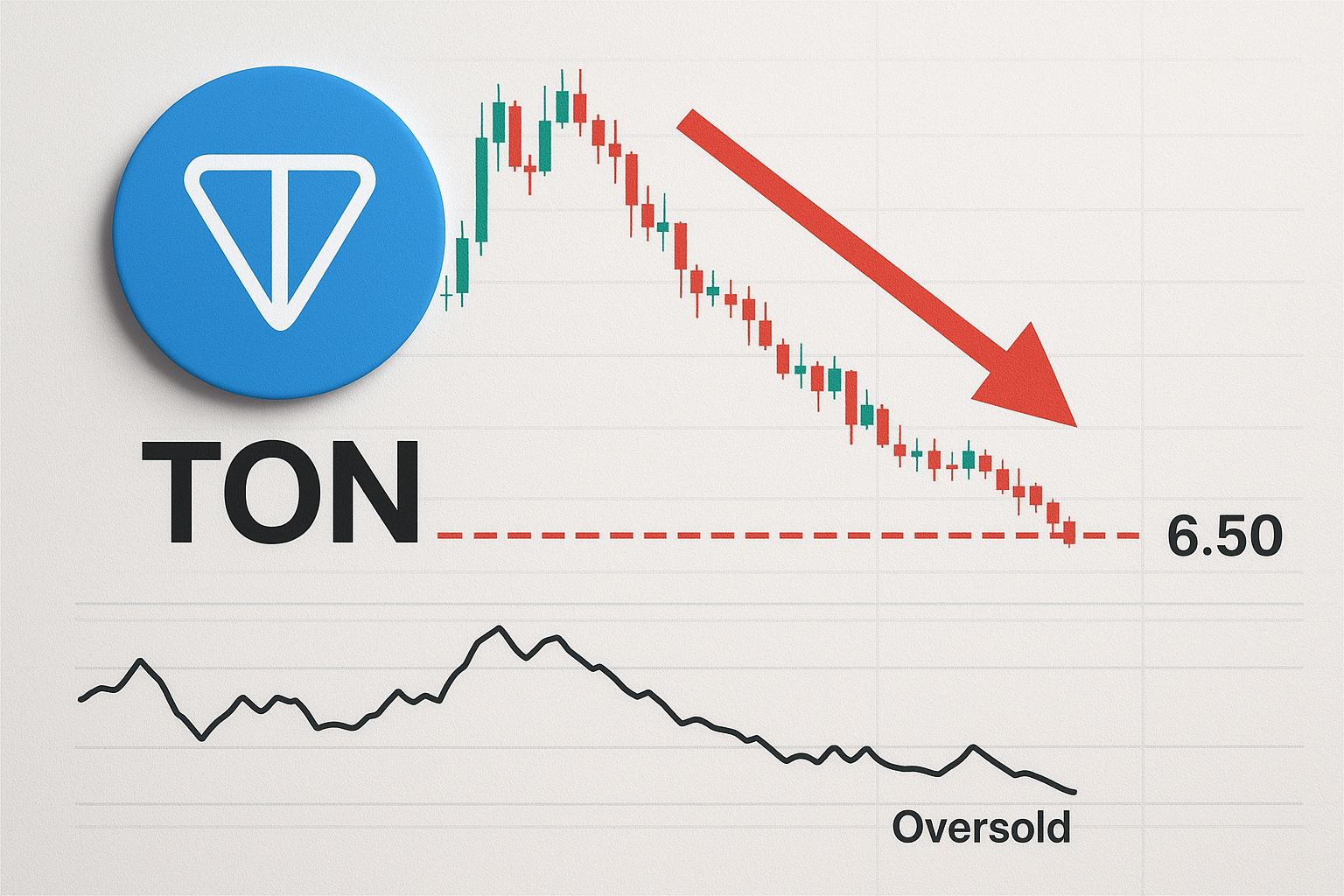
Toncoin Tests Critical Support as RSI Signals Oversold Territory
Market Structure Shifts Lower
- The TON/USDT price is $1.675 as of writing, down 37.9% from the record high reached in late December.
- Looking at the daily chart, the Relative Strength Index (RSI) fell to 39.33 today.
- This is the first time since August that the TON coin has entered oversold territory on the daily chart.
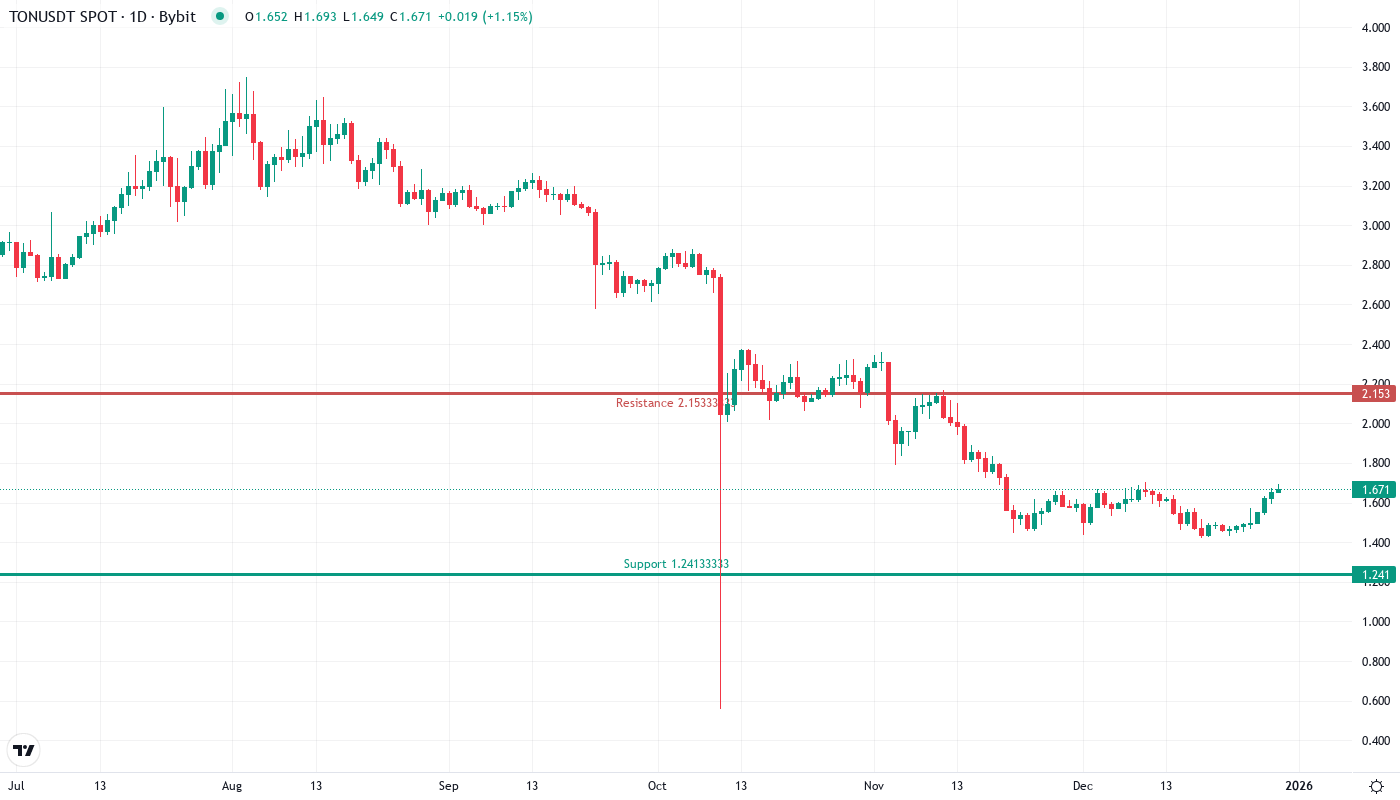
The recent TON slide has been very technically oriented, with the trip beneath the 50-day smoothing level signaling to any computer-driven or trend following strategies looking for crypto buys that it was time to exit the trade. Stressed asset managers who found themselves long Toncoin likely for capitalization weighting reasons also bailed out automatically as the slide made this position overweight in their funds. It felt like a downward spiral of selling had taken hold, one that might only be reversed by the broader market finding its feet and allowing for some relief rallies. It should be noted that if the recent drop plays out as the 27% corrections taken after the similar length 27% rallies in September and January, we could be looking at a move to $1.42 anyhow.
| Metric | Value |
|---|---|
| Asset | TONCOIN (TON) |
| Current Price | $1.68 |
| Weekly Performance | 14.73% |
| Monthly Performance | 5.74% |
| RSI (Relative Strength Index) | 60.2 |
| ADX (Average Directional Index) | 34.0 |
| MACD (MACD Level) | -0.01 |
| CCI (Commodity Channel Index, 20-period) | 130.19 |
RSI Drops to 39.33 – First Oversold Reading Since August Washout
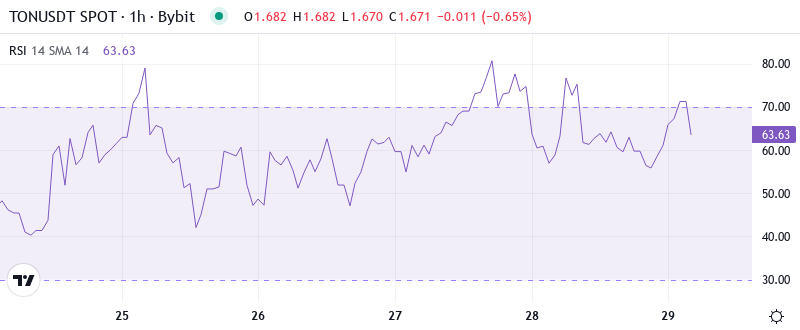
The relative strength index measures the speed and change of price movements. RSI is a very useful and popular momentum oscillator used to compare the magnitude of recent gains to recent losses, in an effort to determine overbought and oversold conditions of an asset. In other words, it shows how strongly and in which direction the price is moving. Changes in the RSI can indicate the likelihood of the recent trend continuing or reversing. An RSI of 70 or above indicates an asset is overbought, while an RSI of 30 or below indicates an asset is oversold.
What is particularly noteworthy is the behavior of RSI on the way down. It fell below 50 in the first week of December and didn’t manage to climb back into that neutral zone despite several attempts to do so in the weeks that followed. The weekly RSI presents an even more alarming sight. At a mere 17.16, it indicates extreme oversold conditions that typically coincide with either major cycle lows or the beginning of protracted bear markets. For swing traders, this oversold bounce play represents a higher-risk opportunity given the amount of damage that has been done to the technical structure of the market. The potential reward, however, in the event that the expected support does hold, is commensurate with that risk.
ADX at 34.03 Confirms Strong Bearish Trend Remains Intact
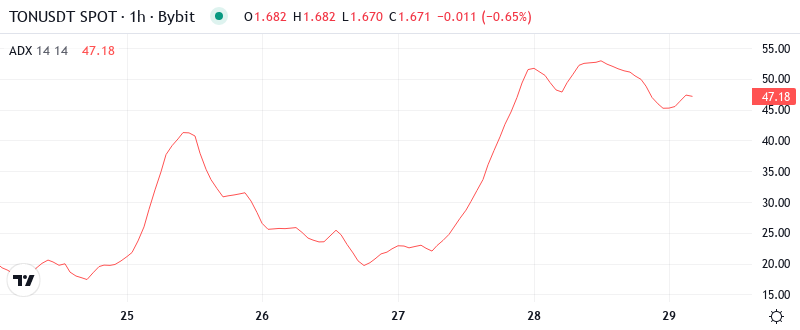
When you look at trend strength indicators, the ADX reading of 34.03 solidifies that sellers are in the driver’s seat. This reading represents a mature trending move not yet in exhaustion territory above 40, indicating a downtrend could continue to expand despite oversold oscillators. In other words, we have the type of sustained directional movement that pretty much obliterates all hope of V-shaped recovery.
For those unfamiliar with TON’s historical “personality”, we describe it as an “ADX monster,” where the price tends to trend almost consistently once ADX breaches 25 (and especially once it passes 40). ADX last broke above 25 in late September, marking the beginning of an almost relentless three-month uptrend that saw the price increase by a multiple of almost 10.
Former Support at 20-Day EMA Now Acts as Dynamic Resistance
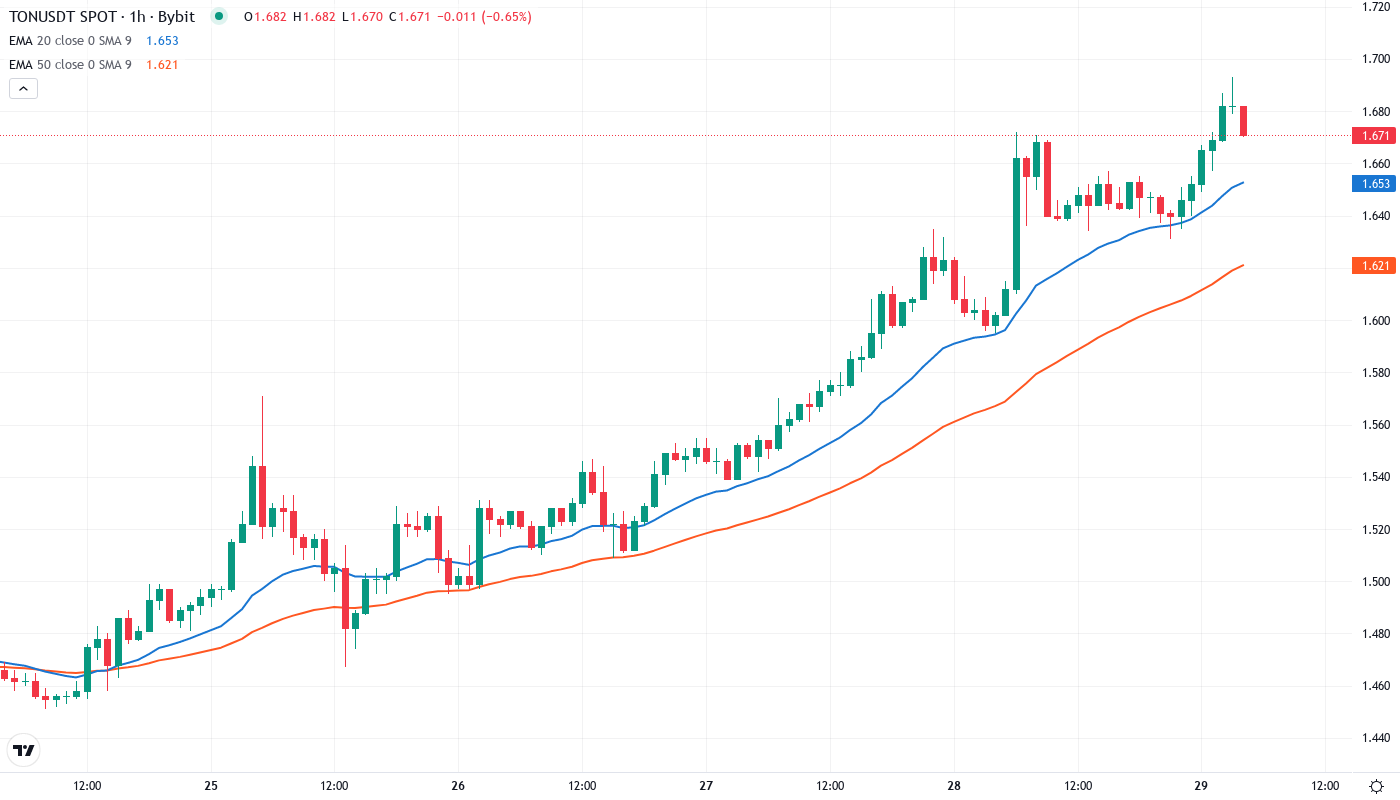
The price action in the EMA ribbons is bearish. TON is below all the key daily EMAs. The first relief rebound was rejected by the 10-day EMA ($1.57), the second by the 20-day ($1.59). The 50-day EMA is coming in at $1.69, only a few cents above the current price. This EMA will likely reject any more substantial bounces. Thus, a clear, three-tier EMA downtrend has been established.
There are four key levels to watch moving forward. First potential seller capitulation around $1.52, which was 30% away at the time this was written, so we clearly have a potential spike low candidate. The next resistance clustering between $1.57-$1.69 is discussed. We get other potential support in a downside price exploration to $1.26, an area around $1.35.
$1.42 Monthly Low Becomes Line in Sand for Bulls
There is significant resistance in the $1.69–$1.79 zone given the confluence of the 50-day EMA and the weekly pivot point. The 38.2% Fib of the recent decline is also located inside this zone. Any rally is likely to be capped here. After that, the $2.00 level is the final hurdle before open air towards the last lower high of $2.25.
Bulls are now fighting with all their might to keep the $1.42 monthly low from 2023 playing out. This level has six touches over the past eighteen months, with each producing a multi-week bounce – though notably, each successive bounce peaked lower than the last. Volume has increased noticeably on the recent test, which could be in part institutional accumulation, though it could also be longs from higher levels getting caught and finally throwing in the towel.
The overall market trend seems to be bearish, as shown by the descending channel. New resistance is building near $1.79, with a current price of about $0.87. Buyers are expected to meet resistance near the 50% Fibonacci retracement point of price declines from mid-October to the recent lows. If they can overcome that level, they should continue to face supply pressure between $1.65-$1.75.
Bears Target $1.35 Unless Bulls Reclaim $1.79 Resistance Cluster
If the price reclaims the $1.79 resistance zone and closes above it for a day, bulls may likely test $2.00 psychological resistance, the place December’s breakdown started. Overextended circumstances in combination with bullish news, such as Telegram’s NFT release and the Uzbekistan wallet launch, could act as a fuel for a hunt on upside liquidity. However, the volume must follow the breakout.
If selling accelerates, the bears will certainly want to claim the $1.35-$1.20 area. Forceful evidence will be necessary from the bulls to defend the 2023 support. The bearish scenario would manifest lower weekly closes, downside volume, and negative news sentiment. The V-recovery establishes $1.42 weekly support before trending toward $1.52.
Considering the oversold bounce risk bar against the still rising wedge pattern, our base case view from here is a bit more chop back and fill trade between $1.42 – 1.69 while working off the extreme readings in momentum. Another 2-3 weeks of this price action will set up for the next more lasting directional move. This will give enough time for traders to handicap and adjust to either outcome while making sure no unnecessary risk is taken.