TAO Tests Critical Support at $260 After December Halving Event
Market Structure Shifts Lower
- TAO drops 22.5% this month following its first-ever halving, finding buyers at $260
- Technical indicators reset from overbought extremes as price tests multi-month support
- Bulls defend the $262-$300 zone that held throughout Q4 despite broader market weakness
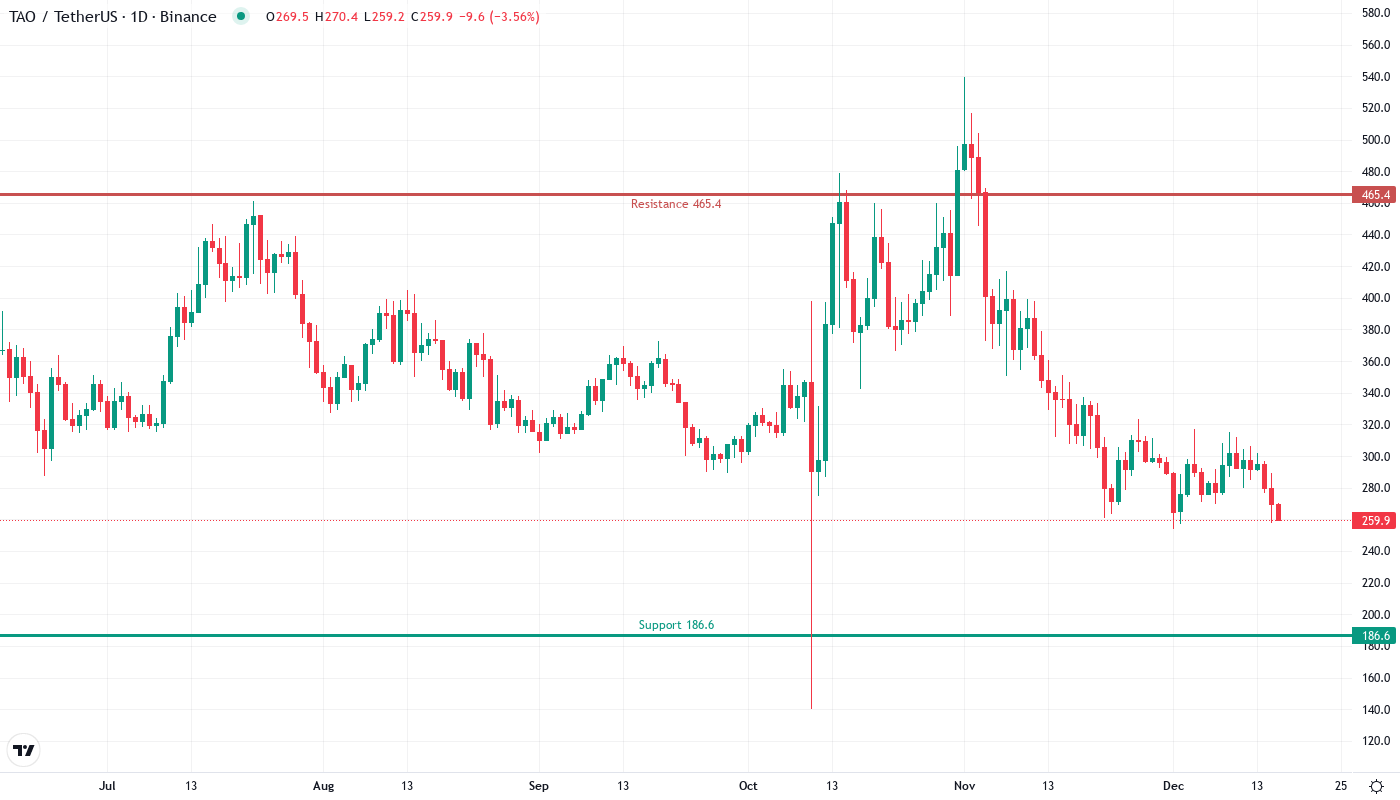
Bittensor’s TAO has shed $75 from December highs, tumbling 22.5% over the past month as the market digests the protocol’s first halving event. The token’s issuance reduction by half triggered an initial sell-the-news reaction, with price sliding from $337 to test critical support at $260 – a level that’s attracted buyers consistently since October. The main question for traders is: will this halving-driven supply shock provide the catalyst for a recovery, or does TAO need deeper capitulation before finding a sustainable bottom?
| Metric | Value |
|---|---|
| Asset | BITTENSOR (TAO) |
| Current Price | $260.20 |
| Weekly Performance | -11.59% |
| Monthly Performance | -22.51% |
| RSI (Relative Strength Index) | 36.8 |
| ADX (Average Directional Index) | 18.5 |
| MACD (MACD Level) | -12.88 |
| CCI (Commodity Channel Index, 20-period) | -164.26 |
Momentum Exhaustion Signals Capitulation Phase Near Completion
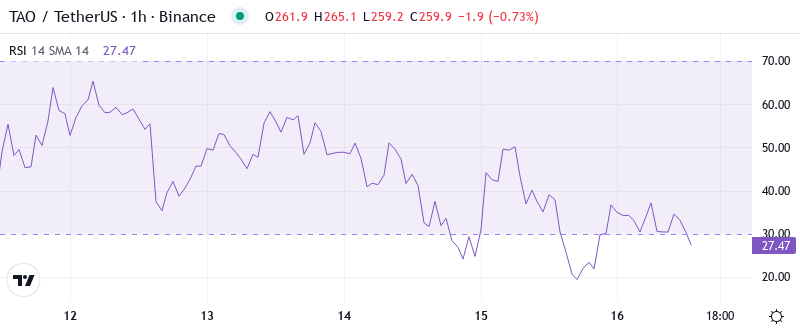
RSI sits at 36.8 on the daily timeframe, marking the first oversold reading since the August washout that preceded a 65% rally. What’s revealing is how momentum collapsed alongside the halving announcement – a classic sell-the-news pattern where anticipation exceeded reality. The oscillator’s journey from 70+ readings in early December to today’s oversold territory represents one of the sharpest momentum reversals in TAO’s trading history.
Similar RSI configurations in September and October saw TAO bounce within 3-5 days of hitting the 30-35 zone. So for swing traders, this oversold bounce setup offers a measured risk entry, especially with the halving’s supply reduction now baked into the price. The key difference this time is the fundamental backdrop – reduced issuance should theoretically support prices once the initial distribution pressure subsides.
Weak ADX at 18.48 Confirms Range-Bound Conditions Return
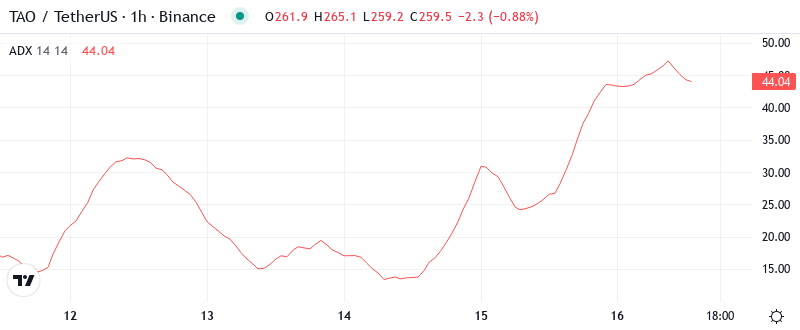
At the level of 18.48, the ADX entry indicates that TAO has shifted from trending to choppy conditions following December’s directional move. The trend strength indicator peaked above 40 during the November rally, then steadily declined as price action compressed into the current $260-$340 range. Basically, being in this zone below 20 means neither bulls nor bears control the tape – it’s a trader’s market rather than an investor’s market.
To clarify, the ADX is indicating that we are switching from the post-halving volatility spike back to accumulation mode. Therefore, day traders should suit their strategies to this change – expect failed breakouts, stop hunts, and choppy two-way action until ADX climbs back above 25. The halving event created the volatility spike, but now the market needs time to find equilibrium with the new supply dynamics.
50-Day EMA at $315 Becomes Resistance After December Breakdown
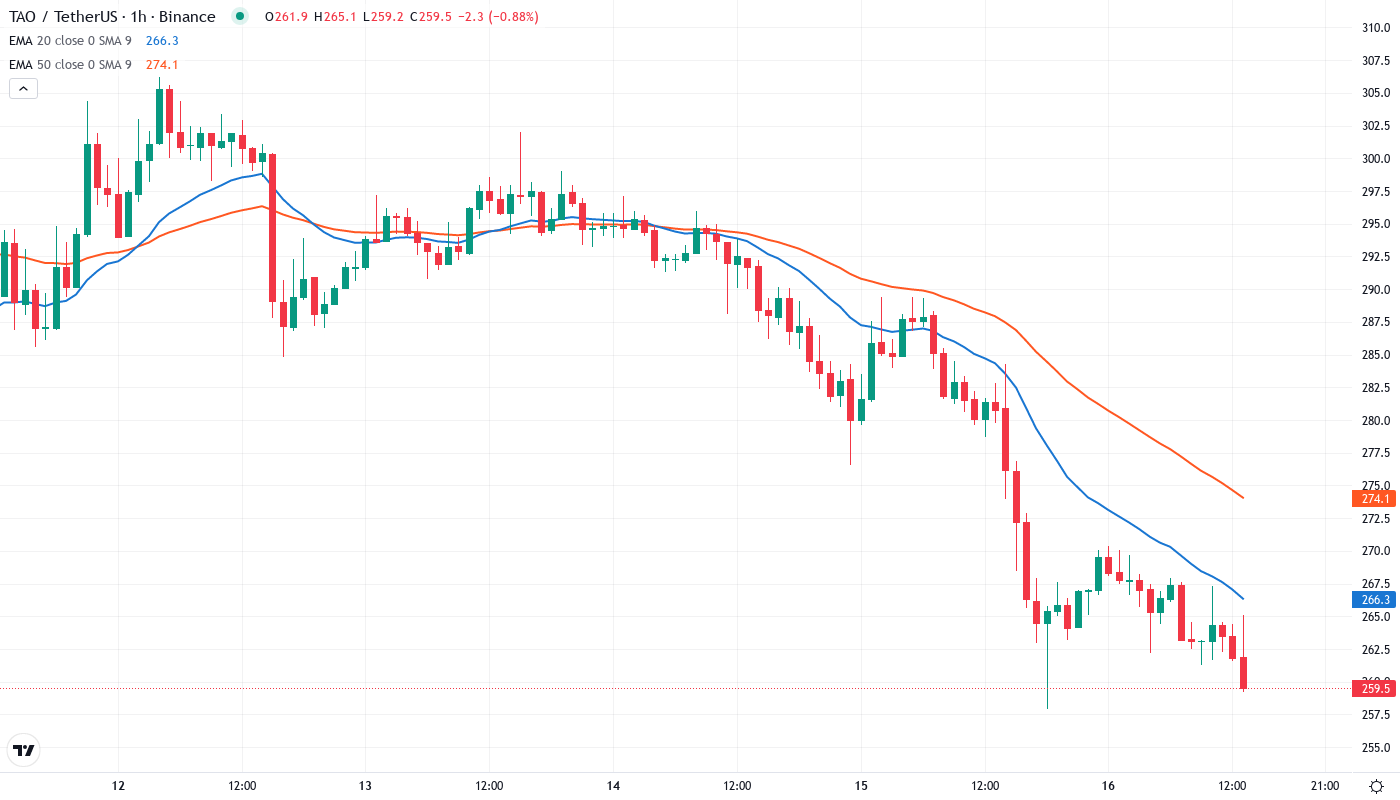
Price action is very clear through the EMA ribbons. TAO is positioned below the 10-day ($281), 20-day ($290), and more importantly, the 50-day EMA at $315 – a level that supported price throughout the pre-halving rally. The 50-day EMA changed from being a support level to a resistance one after December’s breakdown, with two rejection attempts already printed on the daily chart.
Looking at the longer-term structure, the 100-day EMA at $334 and 200-day EMA at $348 sit far overhead, creating a resistance stack that will take significant buying pressure to overcome. That former support area at $315 now transforms into a red line for the bears to defend. The halving-induced selling pushed price below the entire EMA complex in one decisive move – bulls need to reclaim at least the 20-day to shift near-term momentum.
Support Architecture Builds From $260 to $300 Post-Halving
The immediate resistance is set at the zone from $315 to the high of $337 where December highs meet the 50-day EMA. Above that, sellers have stacked orders at the psychological $350 level where the 200-day EMA converges with round number resistance. The halving announcement initially pushed price to test $337, but profit-taking quickly emerged as traders locked in gains ahead of the actual issuance reduction.
Bulls defend multiple support layers between $260 and $300, with the most critical being the $262 level that’s held on six separate tests since October. The monthly pivot at $288 provides intermediate support, while $254 marks the absolute floor from November’s sweep. It is worth mentioning that each bounce from the $260-$262 zone has shown decreasing volume – suggesting accumulation by patient buyers who understand the halving’s long-term implications.
The structure of the market signals buyer’s power as long as they can keep $260 above in any kind of retracement. This configuration resembles a descending triangle with support holding firm while resistance gradually lowers – typically resolved with a violent move in either direction once the pattern completes.
Halving Supply Shock Sets Stage for Q1 Recovery Above $315
Bulls must secure a daily close above $315 to flip the 50-day EMA back to support and confirm the halving-driven accumulation phase is complete. Should price reclaim this level with volume, the measured move targets $365 while the reduced TAO issuance provides the fundamental tailwind for sustained appreciation.
The bearish domino falls if price drops below $260 on a daily close with expanding volume – this would trap recent halving buyers and likely trigger stops down to $230. Crucially, losing the $262 support that’s held since October would signal that even the 50% supply reduction isn’t enough to attract buyers at current levels.
Given the oversold RSI, support holding at $260, and the halving’s supply dynamics still working through the market, the most probable near-term path is for TAO to build a base between $260-$300 before attempting to reclaim the 50-day EMA. The reduced issuance should gradually shift the supply/demand balance, but markets need time to adjust to new equilibrium levels post-halving.