JUP Tumbles 41% as Security Breach Rattles Solana Ecosystem
Market Structure Collapses Lower
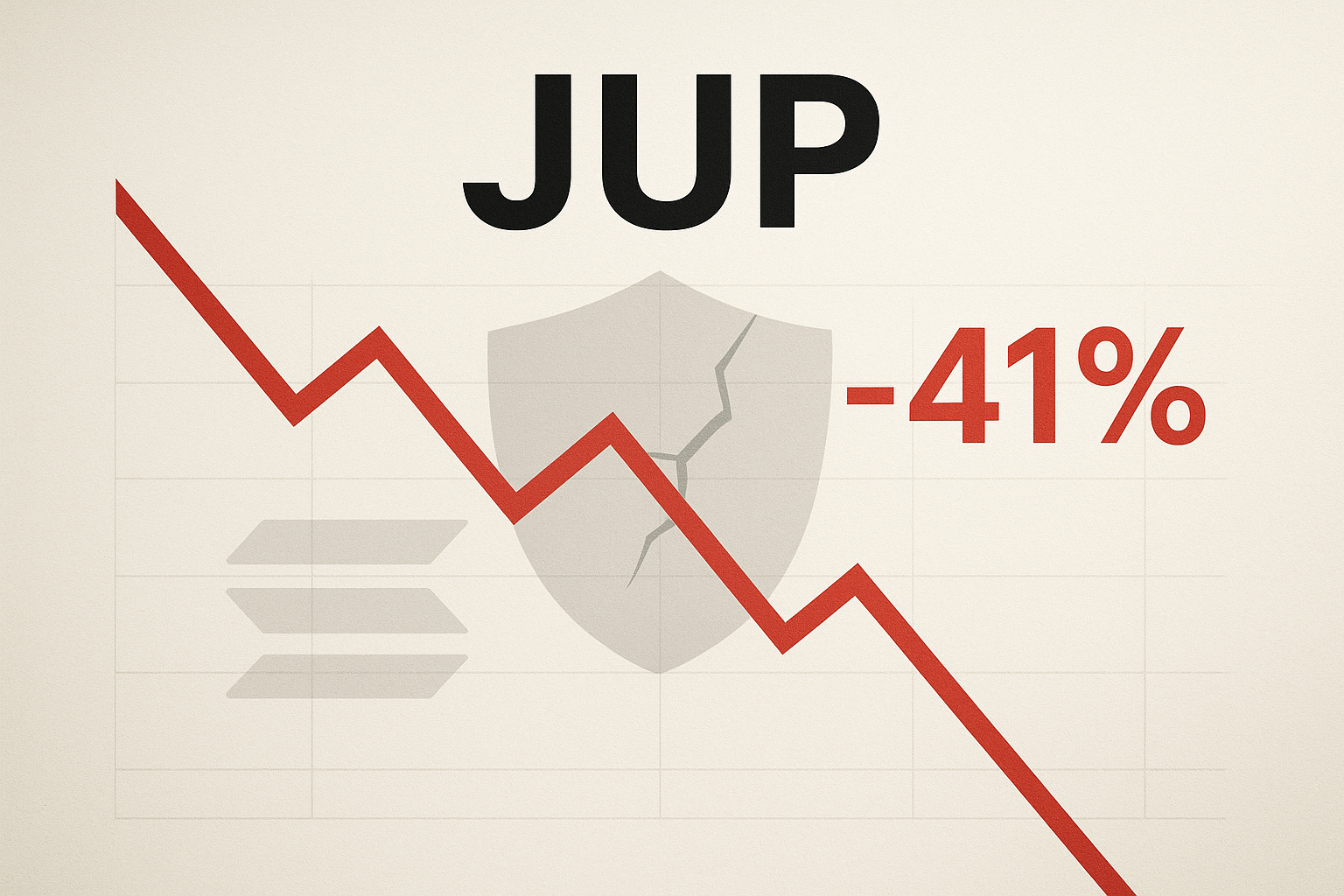
- JUP crashes to $0.25 after devastating 41% monthly decline – worst selloff since launch
- Security breach involving stolen Jupiter tokens triggers stop-loss cascades below key support
- ADX at 43 signals genuine trend strength building – unfortunately for bulls, it’s pointing down
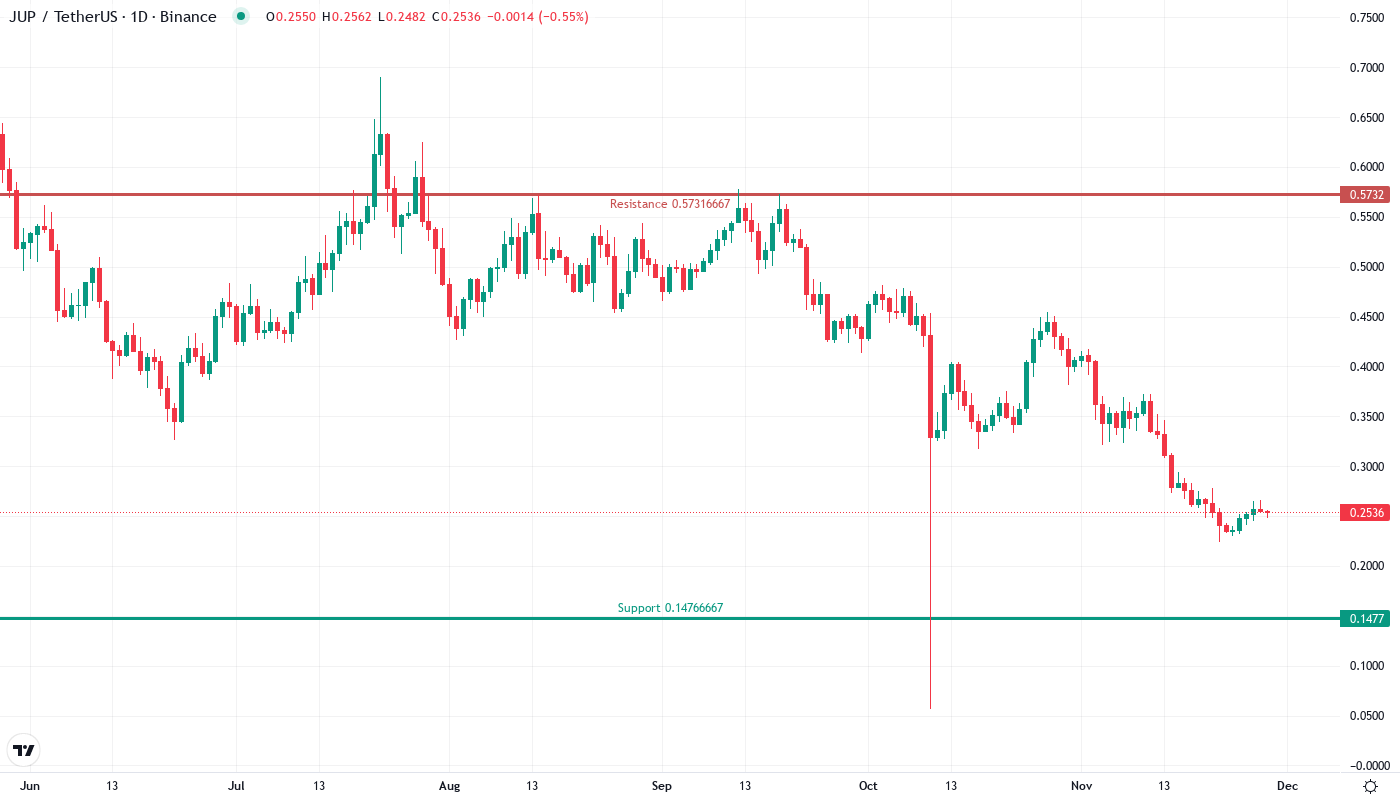
Jupiter’s price action tells the story of a token in freefall, with JUP plummeting 41.22% over the past month to trade at $0.2531 – a devastating drop that erased over half its value from recent highs. The Upbit security breach that saw $36M worth of Solana ecosystem tokens stolen, including Jupiter, triggered panic selling that overwhelmed any positive sentiment from the Metis v7 spinoff announcement. The main question for traders is: has JUP found a floor at these levels, or does the technical structure suggest more pain ahead?
| Metric | Value |
|---|---|
| Asset | JUPITER (JUP) |
| Current Price | $0.25 |
| Weekly Performance | -0.43% |
| Monthly Performance | -41.22% |
| RSI (Relative Strength Index) | 33.9 |
| ADX (Average Directional Index) | 43.1 |
| MACD (MACD Level) | -0.03 |
| CCI (Commodity Channel Index, 20-period) | -54.70 |
Momentum Exhaustion Signals Capitulation Phase Complete
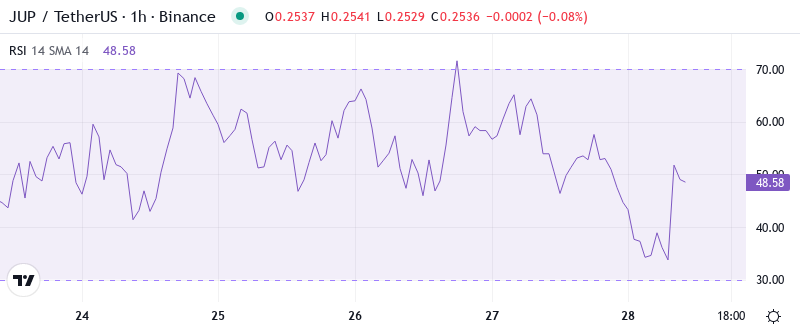
RSI sits at 51.53 on the daily timeframe, marking a surprising recovery from what must have been deeply oversold conditions during the recent crash. What’s revealing is how RSI behaved during this collapse – the indicator likely plunged well below 30 during the steepest declines before bouncing back to neutral territory, suggesting the most aggressive selling pressure has exhausted itself.
Similar RSI configurations following security-related selloffs in the Solana ecosystem have historically marked intermediate bottoms, though recovery timeframes varied widely. So for swing traders, this balanced RSI means the panic phase appears complete, but it doesn’t guarantee an immediate reversal – more likely a period of base-building as the market digests the security implications and waits for confidence to return.
ADX at 43 Confirms Mature Downtrend Nearing Exhaustion Point
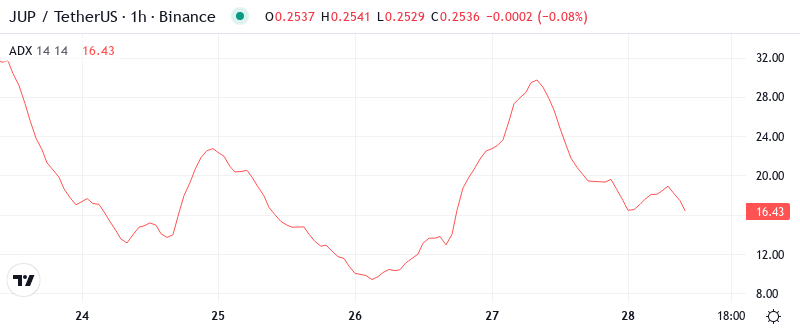
Looking at trend strength, the ADX reading of 43.12 flashes a clear warning – this isn’t some minor correction but a full-blown trending move with real conviction behind it. Basically, when ADX climbs above 40, it signals that one side has taken complete control of the market, and in JUP’s case, that’s been the bears who’ve driven price down relentlessly since the security breach news broke.
Interestingly enough, such extreme ADX readings often coincide with trend exhaustion rather than continuation. The combination of a 41% monthly decline and ADX above 40 suggests we’re approaching the kind of capitulation zone where selling pressure typically peaks. Therefore, contrarian traders should prepare for potential mean reversion opportunities, while trend followers might consider taking profits on short positions given the mature state of this downtrend.
Price Trapped Below Entire EMA Cloud Since Security Breach
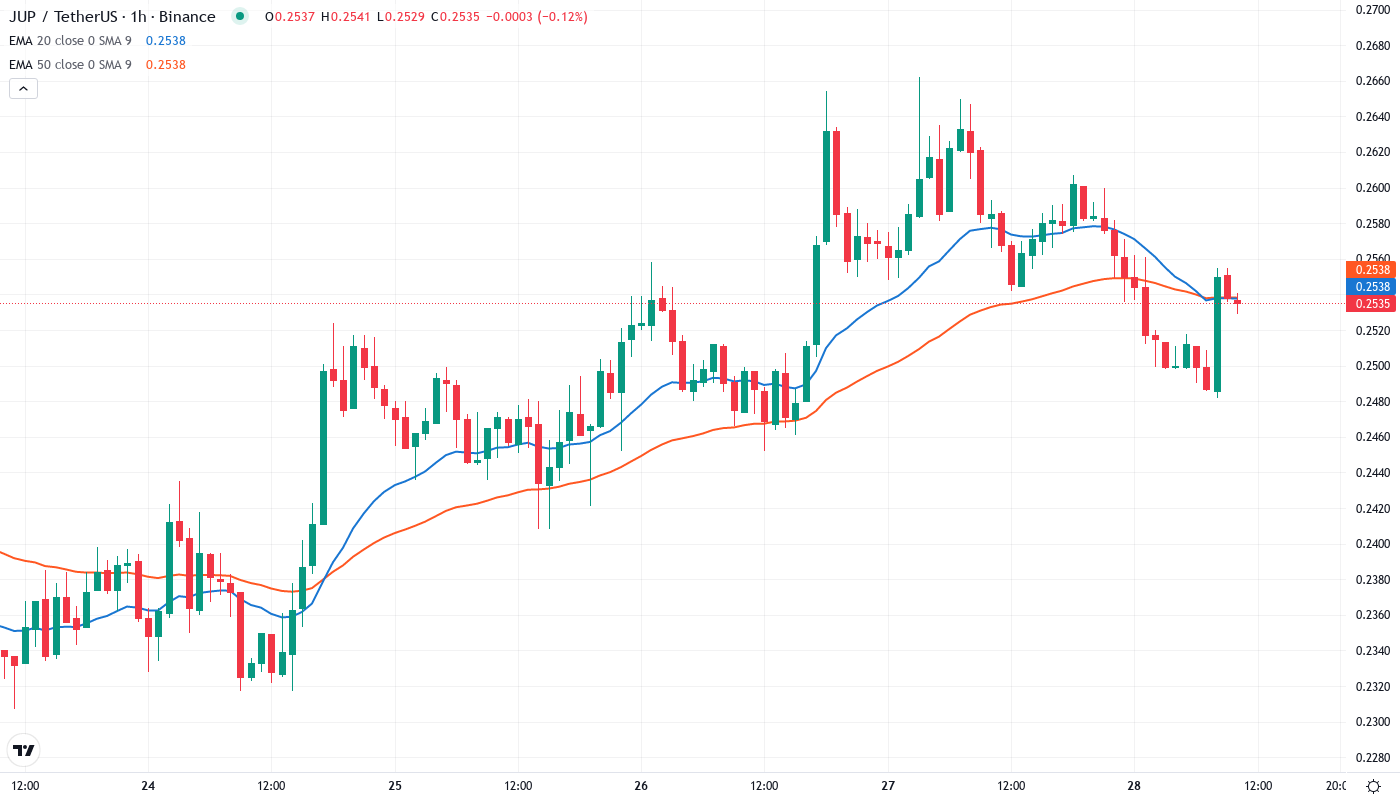
The moving average structure paints a grim picture for bulls. JUP trades below every significant EMA – the 10-day at $0.257, 20-day at $0.278, and critically, the 50-day EMA at $0.299 which previously acted as support multiple times before the breach. Each of these levels transformed from support to resistance during the cascade, creating a stacked barrier that price must overcome to signal any meaningful recovery.
More telling is the compression between these averages and current price – roughly 20% below the 50-day EMA represents an extreme deviation that typically doesn’t persist for extended periods. The security-driven selloff pushed JUP into oversold territory on multiple timeframes simultaneously, and while the immediate danger appears past, bulls need to reclaim at least the 20-day EMA at $0.278 to shift the technical structure from bearish to neutral.
Support Vanishes Below $0.25 as Bulls Make Last Stand
Above current price, sellers have stacked multiple resistance layers that coincide with both technical levels and psychological round numbers. The immediate resistance zone spans from $0.278 (20-day EMA) to $0.299 (50-day EMA), with the psychological $0.30 level adding extra weight to this ceiling. Beyond that, the monthly pivot at $0.359 and the 100-day EMA at $0.332 create a formidable barrier between $0.33-0.36 that would require significant buying pressure to overcome. On the downside, the $0.25 level where JUP currently trades represents the last line of defense for bulls – there’s essentially an air pocket below with no historical support until the $0.15-0.17 zone. The security breach created a liquidity vacuum as market makers widened spreads and reduced inventory, leaving few natural buyers to cushion further declines. This absence of support structure makes any break below $0.25 particularly dangerous.
The market structure signals extreme vulnerability as long as JUP remains below $0.278. Bulls desperately need to defend the $0.25 psychological level that’s provided a temporary floor, but the lack of volume and the security overhang suggest this support remains fragile. The Metis spinoff news failed to generate buying interest in the face of security concerns, highlighting how fundamental catalysts struggle to overcome technical breakdowns of this magnitude.
Recovery Requires Sustained Close Above $0.278 to Rebuild Confidence
Bulls must secure a daily close above the 20-day EMA at $0.278 with accompanying volume to signal the bleeding has stopped. Should JUP reclaim this level and hold it on a retest, the next targets would be the 50-day EMA at $0.299 and ultimately the psychological $0.30 barrier. The Metis ecosystem development provides a fundamental narrative for recovery, but price needs to prove itself technically first.
The bearish scenario triggers if JUP loses the $0.25 support on volume – such a breakdown would likely flush positions down to the $0.15-0.17 zone where some historical price memory exists. Given the complete absence of support below current levels and the security-related selling pressure, any daily close below $0.245 would signal the next leg lower has begun, potentially targeting a 40% additional decline from here.
Taking into account the extreme oversold conditions, neutral RSI reading, and mature downtrend indicated by ADX above 40, the most probable near-term path is for JUP to attempt a relief bounce toward $0.278-0.30 resistance before sellers reassert control. The security breach impact will take time to fade from market memory, suggesting a prolonged base-building period between $0.20-0.30 before any sustainable recovery can materialize.