Solana Tests $136 Support as ETF Launches Collide With December’s Selloff

Market Structure Shifts Lower
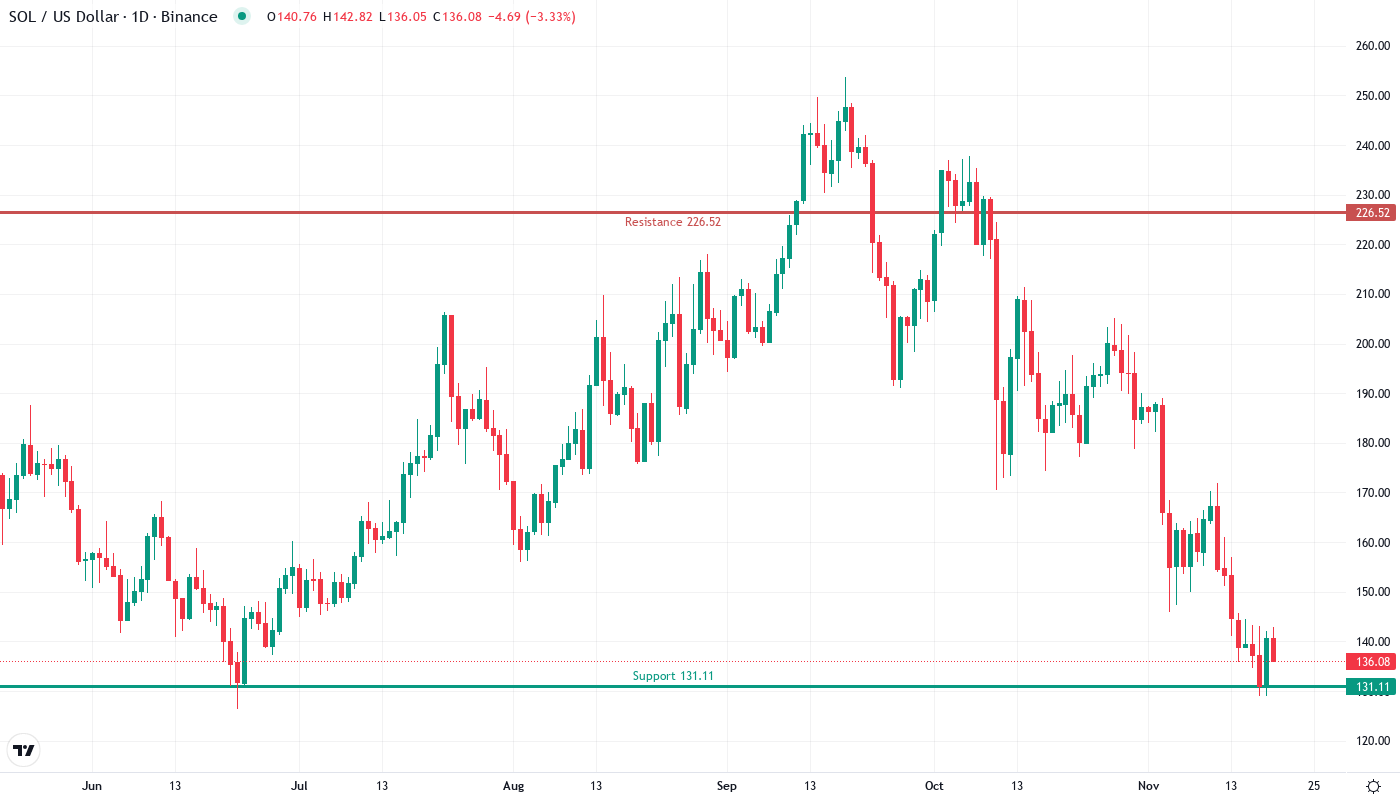
- SOL has dropped 27% from a monthly high near $205, testing the $136 support level six times since late November.
- RSI normalizes at 48.72 after overbought extremes; ADX rises to 46.5, signaling a mature downtrend nearing exhaustion.
- Key resistance at the 20-day EMA ($154) and the $159–$198 zone; ETF catalysts loom.
The price of Solana’s SOL token has lost 27% from a monthly high of around $205 as the broader cryptocurrency market correction deepened. The $136 level has been tested six times since late November.
The state of the market keeps everyone glued to their screens. Following a three-month long deep gut-check, bullish optimism adopted a surprisingly fast pace thanks to the aforementioned ETF launch and HFT trading by no less than a dozen Wall Street giants. The latest flood of institutional liquidity into the former DeFi leader made it the market’s strongest performer in November, as its 60% gain against Bitcoin and 10% gain against Ethereum crowned it the undisputed ‘ALTCOIN KING’ that month. If history repeats, then this could be your last opportunity to accumulate SOL under $150 before it powers onward and upward to its next all-time high. Wow… impatient markets, eh?
| Metric | Value |
|---|---|
| Asset | SOLANA (SOL) |
| Current Price | $136.84 |
| Weekly Performance | -11.59% |
| Monthly Performance | -27.14% |
| RSI (Relative Strength Index) | 34.1 |
| ADX (Average Directional Index) | 46.5 |
| MACD (MACD Level) | -14.01 |
| CCI (Commodity Channel Index, 20-period) | -98.75 |
RSI at 48.72 Signals Neutral Territory After December’s Overbought Extreme
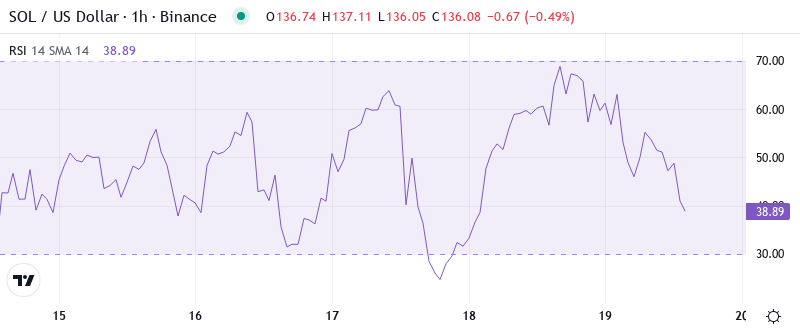
The RSI currently sits at 48.72 on the daily timeframe. It is a complete reset from the overbought conditions that SOL was experiencing above $200. A reading of neutral means that the oscillator has room to travel in either direction with no immediate pressure from extreme levels. The sharp descent from overbought above 70 to the current level is similar to the September correction, in which identical RSI configurations led to a multi-week consolidation phase before the subsequent directional move developed.
Therefore, SOL tends to build a base when the RSI is meandering around the 45-55 mark. SOL has been hovering around these levels since May. Furthermore, previous expansions off such bases were 618% in 70 days (Feb 2021) and 424% in 230 days (Apr 2020). Cue the FOMO ahead of the potentially catalytic European launches.
ADX Climbs to 46.5 – Mature Downtrend Nearing Exhaustion Zone
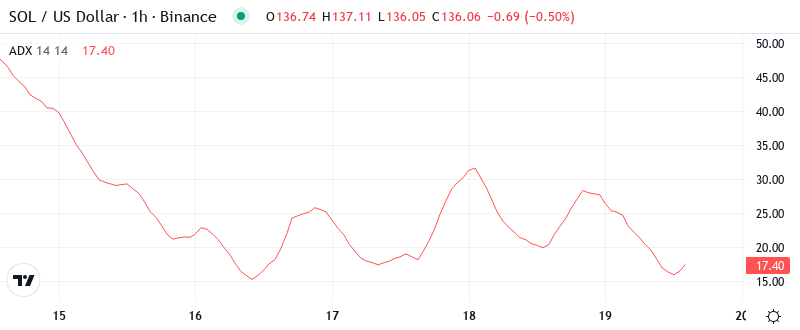
At 46.5, the ADX reading screams that we are in a very powerful trending environment — in this case, a downtrend that is getting close to historical reversal levels. To be more specific, readings above 40 define a mature trend that is increasingly ripe for exhaustion and a turn. The jump from below 25 just several weeks to current extremes is one of the sharpest ADX accelerations throughout SOL’s recent past.
So, day traders, no matter your bias, be on high alert and have a game plan. Our Over/Under Zero strategy is perfect for periods like these. Look for the “oversold” signal as/if price makes a new low and ADX begins to turn.
20-Day EMA at $154 Becomes First Major Resistance Target
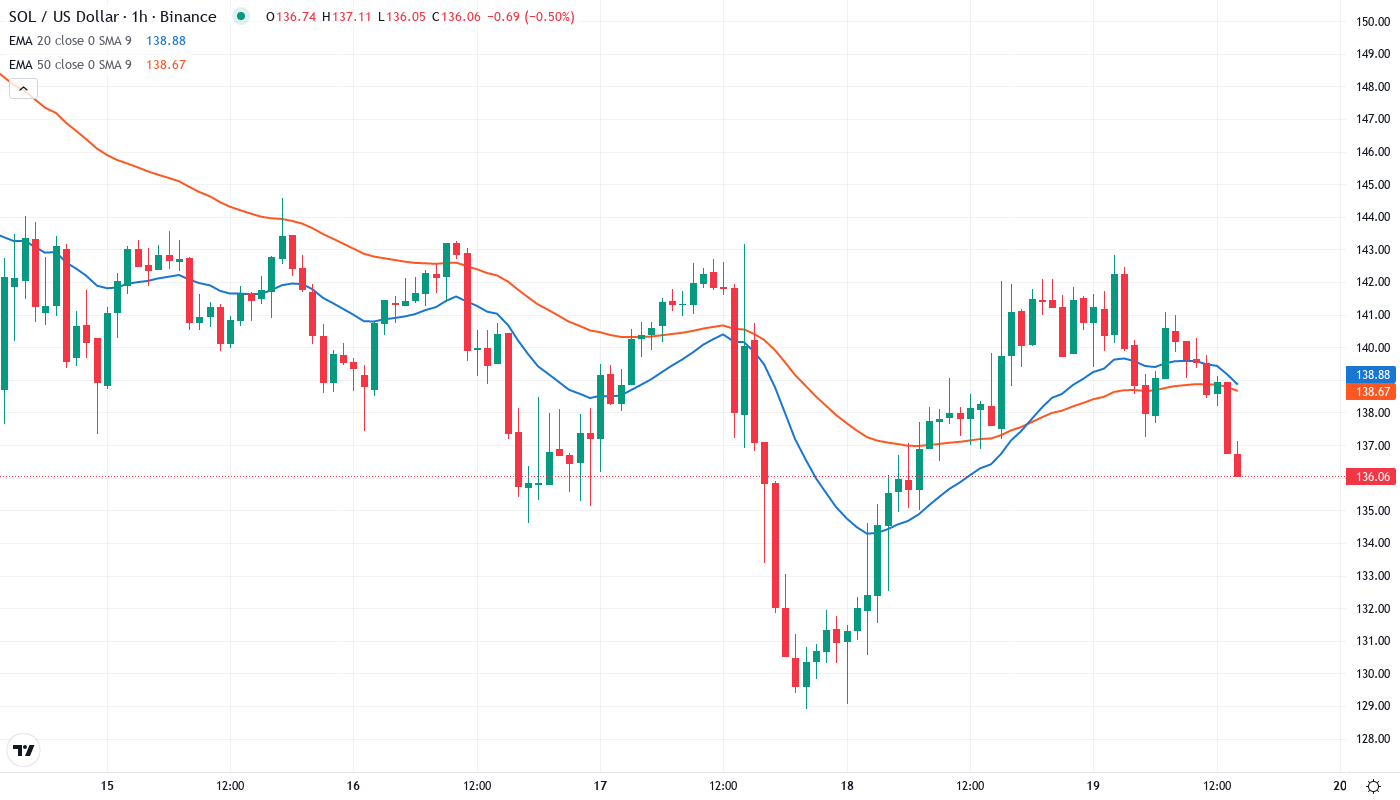
Looking ahead, securing a daily candlestick close above the 10-day EMA seems a logical first step in repairing the damage. Beyond that, the 20-day EMA will likely act as the next battleground on the road to recovery. A daily close below the psychological level at $200 opens the door for a likely test of the aforementioned key support at $183, Fortune 500 spot at $163.98, and potentially the 200-day EMA.
When looking at the bigger picture, the previous support region between $154-163 turns into a resistance area that bulls need to overcome to change the trend. The area between current price levels at $136 and the 200-day EMA at $131 forms a decisive zone of the uptrend crossroads. In this context, it is important to note that institutional ETF flows usually require several weeks until they are reflected in the spot market, which means that the efforts to recapture the moving average could boost during January. Current EMA structure implies further pressure, until bulls demonstrate they can support prices above the 20-day.
Resistance Stacks Heavy From $159 to $198 While $128 Anchors Support
Resistance is expected at $159.17, which is where the weekly pivot point coincides with the 50-day EMA. Further above, resistance levels are seen at $167 (monthly R1) and $185 (psychological level). The monthly high is located at $205. Support is seen at $150, $140, and $122. As can be seen, the digital asset has a lot of support levels below it compared to the upside.
Bullish investors prefer a more orderly ascent, combined with a volume surge that forces weak-handed shorts to cover losing positions. In turn, this virtuous cycle can attract sidelined capital, adding fuel to the buying spike. Persistent upside is unlikely in the first quarter, given the seasonality headwind, but a rally back to the November high could signal a new uptrend in the making.
Importantly, market structure suggests a compressed phase between $128-159 that could be a coiled spring. Spot Solana ETFs from 21Shares and Fidelity, with the latter announcing management fees will be waived until 2026, make for a fundamental catalyst not in previous consolidations. This institutional adoption narrative runs head-on into technical resistance. A tug-of-war situation, where headlines could signal who ultimately will force the next market structure escape.
ETF Catalyst Meets Technical Crossroads at $136
For recovery, bulls need to close above the 20-day EMA at $154 to indicate more upside. If that happens, it could mean new capital is flowing into the ETF story and the $167-185 resistance zone from where pricing broke down in December could be the next target.
If the overall market corrects, potential support zones begin at $90-100 based on prior accumulation volume. Significant historic resistance-cum-support between $68-86 may act as a final defense before price resumes price-discovery auctioning or trend structure failure. This thesis would be invalidated by price recovering lost support and flipping majors as a backstop for other regional fiat-denominated price floors, such as $90-100.
With most larger moving averages lurking overhead, reaction highs at $137.77 and $142.51 add resistance, followed by the 13-day EMA ($141.22) and the psychologically important $150 benchmark. Should coordinated product launches spark a breakout, renewing highs by SOL’s previous top at $174.98 then ventures into the unknown, followed by the 127.2% minimum Fibonacci extension stating just beneath $200.